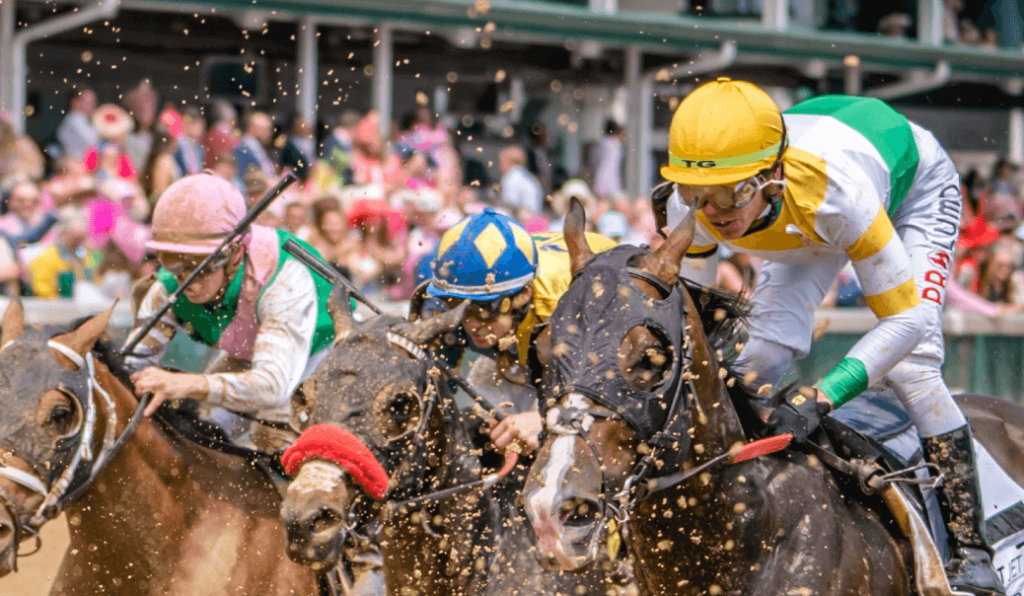
It’s another Arlington meet, and for many fans it means adjusting to an artificial racing surface, again.
Last year was the first year for Polytrack at Arlington. Unless fans had followed racing at other venues with an artificial surface, handicapping Poly for the first time was a new challenge.
Fans should feel more comfortable with Poly now, with experience under their belt. The adjustment to Poly this year should be quicker, more seamless, and more productive.
We have heard the phrase “Horses for Courses.” As originally coined, the phrase implied that horses may prefer one racetrack over another, or they may prefer racing on a dry track as opposed to a sloppy or muddy track. With the expansion of turf racing, the phrase was applied more broadly to indicate that some horses may prefer to race on the grass as opposed to racing on the main track. In recent years, an additional consideration has arisen. Do some horses prefer racing on an artificial surface to racing on a traditional surface? Taking it one step further, do some horses prefer one type of artificial surface over another?
Here are my questions to you, to start our discussion and meaningful exchange of ideas and suggestions.
I have additional questions on my list, but let’s save those for later and see where the questions above take us.
I also have a list of people I fully expect to contribute to this discussion. Don’t let me down. Sign in and chime in now, and keep the dialogue going.
While a foal is far too
While a foal is far too young to be ridden, it is still able to learn skills it will need later in life. By the end of a foal's first year, it should be halter-broke, meaning that it allows a halter placed upon its head and has been taught to be led by a human at a walk and trot, to stop on command and to stand tied. The young horse needs to be calm for basic grooming, as well as veterinary care such as vaccinations and de-worming. A foal needs regular hoof care and can be taught to stand while having its feet picked up and trimmed by a farrier. Ideally a young horse should learn all the basic skills it will need throughout its life, including: being caught from a field, loaded into a horse trailer, and not to fear flapping or noisy objects. It also can be exposed to the noise and commotion of ordinary human activity, including seeing motor vehicles, hearing radios, and so on. More advanced skills sometimes taught in the first year include learning to accept blankets placed on it, to be trimmed with electric clippers, and to be given a bath with water from a hose. The foal may learn basic voice commands for starting and stopping, and sometimes will learn to square its feet up for showing in in-hand or conformation classes. If these tasks are completed, the young horse will have no fear of things placed on its back, around its belly or in its mouth.Some people, whether through philosophy or simply due to being pressed for time, do not handle foals significantly while they are still nursing, but wait until the foal is weaned from its dam to begin halter breaking and the other tasks of training a horse in its first year. The argument for gentling and halter-breaking at weaning is that the young horse, in crisis from being separated from its dam, will more readily bond with a human at weaning than at a later point in its life. Sometimes the tasks of basic gentling are not completed within the first year but continue when the horse is a yearling. Yearlings are larger and more unpredictable than weanlings, plus often are easily distracted, in part due to the first signs of sexual maturity. However, they also are still highly impressionable, and though very quick and agile, are not at their full adult strength.
Scott, good to see that
Scott, good to see that you've joined the on-line generation. I make sure to pick up a Sun-Times before I go to the track.
Has the public figured out the AP polytrack or have the best horses been obvious standouts? Favorites are winning at at higher percentage than normal in '08. I agree that the Horses for Courses phenonmenon does apply to the polytrack but to a lesser extent than turf or sloppy main tracks.
My favorite angle so far early in the meet has been betting against horses who have had early speed success at Hawthorne (if there has been no rain at AP). Hawthorne was such a speed favoring track for most of the meet it made handicapping less fun. I do look at each horse's polytrack record but agree that each polytrack is unique.
When a horse is entered on the polytrack for the first time I do not discount it's past performances on dirt. A good horse will run fast on concrete if it is well prepared. Turf horses seem to prefer the polytrack versus the dirt but they are turf horses for a reason.
I look forward to your blogs for the remainder of the meet.
When it comes to AP Poly I
When it comes to AP Poly I only use AP Poly to rate the horse. It is AP"s Poly and there is no other like it. Those who rate off of dirt and turf will be seen carrying signs on Euclid towards the end of the meet.
John: I love your comment.
John:
I love your comment. Some of those guys are already out there. Perhaps they were also trying to beat the favorite too often.
Hi Scott, Where is Jeremy
Hi Scott,
Where is Jeremy Jet ? Remember when they first tried him on the turf? Good to see you are still around I live on the east coast now. I used to always enjoy your handicapping classes and speed figures.
Always The Best !
Don
Don: Not sure who you are,
Don:
Not sure who you are, based only on the first name and your email handle, but thanks for chiming in.
Of course I remember the good Illinois-bred Jeremy Jet. He was named for the owner's (Bob Curran's) grandson, did you know that?
I remember how upset Bob was with trainer Clifford Scott when Clifford told him, by phone from the Fair Grounds, that Jeremy Jet had been gelded. "There goes any residual value through breeding," exclaimed Bob.
I also remember when Jeremy Jet won the Hawthorne Derby, beating open company (1981?). It was raining, the track was turning "off" and had become speed-favoring. The Jet (as Bob called him) went right to the lead and never looked back. It was the highest speed figure I had ever calculated for an Illinois-registered horse until the Noel Hickey era.
I do remember his turf debut. He really struggled late. Since his daddy held a turf record in England, Jet's connections thought Jet would be a turf star. It was not to be. His preference was the main track.
When are you coming back to visit Arlington? You can email me at mcmannis@horseplayerdaily.com.
Don, Wow, you bring back
Don,
Wow, you bring back memories. I remember a Jeremy Jet trained by Clifford Scott (or was it Scott Clifford?), I want to say ridden by Carlos "HI HO" Silva, who won his first two and then went off at 3-5 in the Issac Murphy Stakes at AP and finished 3rd. That was sometime in the early '80s so I would be very surprised if JJ was still around. As I recall, he was very fast but had distance limitations.
Thanks for the "blast from the past".
meadowlake59: Your memory
meadowlake59:
Your memory rivals mine. Yes, Clifford Scott. And yes, Carlos Silva. Incidentally, do you know how Silva got the Hi Ho nickname?
Be sure to see my response to Don.
BTW, your email handle honors another very fast one. Certainly you remember his first start?
Scott
I very much agree that
I very much agree that "horses for courses applies" to artificial surfaces. There doesn't appear to be any dependable correlation between ability on dirt or turf to that on an artificial surface. Therefore you need to consider the horse's previous efforts on polytrack when handicapping a polytrack race. Polytrack is a unique surface and therefore must be handicapped differently than dirt or turf.
I have had success in polytrack races by using adjusted speed figures earned in previous polytrack races. If the horse has no current polytrack figures, I will use a polytrack figure from last years AP meet. This is much more effective that using a current dirt figure. I subscribe to Scott McMannis' newsletter and use his adjusted speed figures. I find his numbers to be superior to the Beyer numbers.
Additionally, in handicapping a polytrack race I am less concerned about track bias and the pace of the race than I would be for a dirt race unless there is a horse who could be "lone speed". Also you need to pay attention to trainers and jockey/trainer combinations that have had past success on polytrack.
THG4559: All good advice.
THG4559:
All good advice. Obviously you are an advanced handicapper that has learned well.
Did you see my reply to you for your subsequent post to my Part II?
Did you attend my seminar last Saturday (June 28) at Arlington?
Scott
If there is one phenomenon I
If there is one phenomenon I have witnessed over the last two years it is the unmistakable effect that rain has on the poly surface over the one or two days after a heavy shower. Times quicken dramatically; witness opening day when middle and maiden claimers were approaching track record times or if you remember last year, Spotsgone's upset in the Hanshin came a day after a heavy downpour--and he ran the mile in 1:33 and change! I'm not yet convinced that it helps or hurts speed horses (Spotsgone's effort notwithstanding) but I do feel that any previous positive experience in the horse's PPs tends to increase the "after rain" effect.
meadowlake59: You are
meadowlake59:
You are Spot-on (couldn't resist).
Did you see my reply to a similar post regarding the effect of rain?
We can't be sure the rain, and resultant faster track, will help speed horses: I have seen days where it has, and days where it hasn't. That's important to note since too many fans are too anxious to try to declare a track bias, and they get hurt by jumping the gun. Would you agree?
Scott
I do not belive that there
I do not belive that there is a closing bias for a specific type of horse.Some one run style horse will show a kick but only at there perfered distance and class as usual.The workout times of some horse coming into a race have cast some doubt in my mind as to the objective ?
johnny boy: There can be a
johnny boy:
There can be a pace bias that favors closers, although it is much less common now.
I mostly agree with your statement that says late-running horses will show their kick at their preferred distance. How often have we seen a horse with a big close at six furlongs come back in a two-turn route and disappoint? Oftentimes he will make that move at the usual four-to-six-furlong point in the race, then flatten out for the remainder. He made his move, at the time he is used to making it, and it was too early for this particular race.
However, when we are talking about a closer at six furlongs stretching out to a one-turn mile, a race we offer here at Arlington, take a second look. Check the trainer's stats for stretching out. See if the rider is one of the better, experienced ones who will know how to save the horse for the stretch run. The horse just may be coaxed to bide his time down the backstretch, for longer than usual since there still is no turn involved, and make his late move in the stretch.
It is very difficult to use workouts meaningfully in handicapping. In fact, I have written articles for The Racing Times, The Racing Form, and for HorsePlayer Magazine citing all the reasons (20 in the HorsePlayer article) why it is difficult to effectively, consistently, use workouts in your handicapping. If you have been a long-time subscriber to HorsePlayer, you probably read the article.
Scott
I have been dazzled by the
I have been dazzled by the way stretch horses seem to fly on the Polytrack once they come around the stretch and are heading for home.
When studying the past performances, I have started to focus on horses that were almost at the end at the beginning of the past races and then turned it on in the stretch and came in close to the leaders, even if they were not in the money. These horses are real contenders.
Rose Cop: Everyone loves to
Rose Cop:
Everyone loves to watch the big closer go from last to first...unless he nails the horse you bet on at the finish!
Closers need much in their favor to make that dramatic move.
First, they need a good trip since they may encounter traffic problems.
Second, they need a track that is allowing closers to make their move. In other words, a track that is favoring speed that day will prove difficult for a closer to overcome.
Third, they need speed that is stopping. A speed horse with a stamina shortfall (or even a breathing problem) is a sitting duck. Two or more speed horses knocking each other out in a duel helps the closer.
Here's a little tip for only you, Rose Cop. When you see a horse make a big close, write down the fractions and final time. Then calculate the time of the final quarter. You'll be surprised how often that final quarter is pedestrian, and one of the slowest of the day. Thanks to speed stopping, the closer's move is helped to look more dramatic.
If you like closers, always be sure to visualize how the race will be run (you should do this for every race anyway) and ask yourself if he will have a chance to make that move.
We illustrated that at my seminar last Saturday (June 28). If you were there, you know what I'm talking about.
Scott
I have been dazzled by the
I have been dazzled by the way stretch horses seem to fly on the Polytrack once they come around the stretch and are heading for home.
When studying the past performances, I have started to focus on horses that were almost at the end at the beginning of the past races and then turned it on in the stretch and came in close to the leaders, even if they were not in the money. These horses are real contenders.
I have a question for you
I have a question for you Scott. The track is always listed as fast in the past performances. How will I know if it's fast because it was dry, or fast because it stopped raining. With the dirt track I could figure out how it played because it was fast, muddy or good. How will I know this from the information I get on the poly track.
chermo: The Polytrack will
chermo:
The Polytrack will always be listed as fast because it can't be sloppy, muddy, heavy, good, etc. There is no sand/dirt to become any of those designations.
Unfortunately, in the past FAST meant dry. It had nothing to do with the speed of the track, although the word would imply such.
If you want to know how fast the track really was, you will need to calculate a daily track variant to quantify it.
Hope this helps.
Scott
I think either a horse likes
I think either a horse likes Polytrack a lot or not at all. Since the meet is still early, I use workouts as my main tool in handicapping.
I do like the fact that horses can win in different ways here in Arlington, whether on the lead or from behind. Some tracks with synthetic surfaces are impossible to figure out. I like Polytrack racing, but only if it is fair to all runners and not just closers.
hokie 73: I just love some
hokie 73:
I just love some of the handles people are creating for themselves, hokie 73 included. I have no idea what that stands for.
I agree that Polytrack is proving itself to be more fair than the old, traditional surface did.
Workouts?
Scott
Hi Scott...any chance you
Hi Scott...any chance you will be posting your Sun-Times picks in this blog? Many people dont subscribe to the S-T and the paper doesnt put your picks up online, for some reason...
Chris: The Chicago Sun-Times
Chris:
The Chicago Sun-Times web staff tried to post my daily graded handicap on the Sun-Times web site but there were some technical problems. I don't know where you live, but perhaps you can buy a Sun-Times on the days you are coming to the track.
Scott
I agree with the Horses for
I agree with the Horses for Courses phenomenon however I personally have been very cautious when wagering even this year on the polytrack at AP. If I am interested in a race, I will take into consideration the horse's record on synthetic surfaces and if there are 2 or more horses in the race without an artificial surface race under their belt I will usually skip the race. However if I am thinking Trifecta or Superfecta, and now even Super High 5, I may use those horses without polytrack experience on the bottom of the wager in the 3rd 4th and 5th spots.
Hopefully my patience pays off. Its still only May and we have a long meet ahead!
hyerczyk: No quibbles with
hyerczyk:
No quibbles with your early-meet strategies, and I commend your patience.
How about coming back and sharing with us what you are doing now, since we are one-third of the way into the meet and most horses have current Polytrack (or, alternatively, turf) races to use for handicapping?
Scott
Matt- Not sure what you mean
Matt-
Not sure what you mean by "beginner" but the "diamond" symbol in the form indicates race was on an "all weather" (or poly) track. As I said in my last entry, basically this is now a 3 surface sport, so pay attention to how well a horse has run on artificial surfaces (or better yet at Arlington)
If you don't have a list of sires who's offspring have run well on Poly,(Scott, maybe you have a list like this to share) and a horse hasn't run on poly in the past, some people believe that a horse who has run well on turf will handle the poly as well. (If the horse has never run on turf or poly, perhaps the turf tomlinson (needs to be at least 280) could help you a bit. Also, horses who come from Keeneland (also a poly track, but as a rule more talented horses compete there) seem to have done well so far at the meet.
Good Luck
Do any of you more
Do any of you more experienced guys out there have any tips for beginning handicappers and how to figure out polytrack?
mattbd6203: Matt, you should
mattbd6203:
Matt, you should approach Polytrack races the same as you do any other race:
1. Analyze how the horse has run in the past under similar conditions: (artificial, turf, etc., distance, etc.). How fast did he run?
2. Predict how you think he will run today. How fast?
3. Compare those predictions, one against the other, to predict the likely outcome of the race.
4. Ask yourself, "What wagering strategy fits my likely outcome?"
Hopefully you attended my seminar last Saturday (June 28) and saw a demonstration of this approach.
Scott
1. As far as "horses for
1. As far as "horses for courses" I think that "horses for surfaces" would be more applicable. The first key is to accept that this is now a 3 surface sport (Dirt, Turf, Artificial) and trying to use form from one to predict the outcome on another leads to losing tickets.
2.)I've done ok since the switch, and the key has been looking at the breeding. (Joe K. had a nice list last year, and a blogger from DRF put out a list this year that has been very predictive of horses who do well on Poly)
3.) Yes to an extent although terrible recent form usually has nothing to do with the surface and more to do with a problem with the horse As far as horses whove never run on poly BREEDING BREEDING BREEDING the sire and damn sire are critical and accurate predictors of how a horse will run on poly
Watching other tracks I saw
Watching other tracks I saw a horse that may do well at one poly track, do poorly at another. Also, how much does a better drainage system improve the track. If a dirt track also improved their drainage system, would they also see an improvement?
chermo: The horse could have
chermo:
The horse could have done poorly at another track for a whole host of reasons: going off form, sickness coming on, bled through Lasix, back too soon, not back soon enough, trainer change, equipment change (including many changes that we are not notified about), up too late last night due to a party in the next barn, lost a shoe during the race, lost composure in the paddock, had trouble in the race that we cannot know unless we watched the race and took notes, and on and on!
It would take a comprehensive study to determine how one artificial surface positively or negatively corresponds to another. To date, I have seen no such study.
Not to worry, chermo. We are far enough into this meet that there are plenty of races where the horses in the field have had 2-3 races over the track (be it Polytrack or turf), that we can use APPROPRIATE recent history to handicap today's race as I demonstrated at my seminar with handicapped Polytrack as well as turf races.
Scott
I missed much of the first
I missed much of the first AP season, but am hopeful to be more active with it next year. So far, I'm looking for performances on the surface, same with Polytrack as I would with all suraces (dirt, turf, mud, slop, firm, yielding, etc.) to give me a clue, to expect possible improvement/deprovement if they have experience but are changing surfaces. With no experience on it, I'm having to at least keep that thought in mind when looking for a local wager - horses may or may not perform at their dirt level, would they contend if they did helps set a prelminary estimate, but the performance could vary, and if I do wager on or against one of those 'estamated' contenders, I'd better ask for slightly better odds to make up for it.
Stat Man Steve: So, how
Stat Man Steve:
So, how about sharing with us how you are approaching this meet now, since we are one-third of the way through and we have current history on most of the horses?
Especially since I heard a rumor, in the hallowed halls in passing, that you won the Week #2 real-money handicapping contest. Is that so? Are you that guy?
Scott
Yes I belive the "Horses for
Yes I belive the "Horses for courses" applies.Also reguarding first time starters on poly give special consideration to those that have performed avg. to above avg.on turf courses as well as below avg. on dirt surfaces.These reasons have lead to a few nice winners this meet at arlington.